Executive summary
For a long-form SADHNAM Journal essay, the strongest thesis is this: in the Sanatan and nāda-oriented traditions, silence is not a blank after sound but the subtler field in which sound is revealed, absorbed, and fulfilled. The article should therefore avoid the modern cliché that silence merely means “less noise.” Instead, it should show a graded movement from speech to mantra, from mantra to inner listening, and from inner listening to a silence that is experienced as presence, not vacancy. This arc is well supported by the Bhagavad Gita, the Upanishadic literature on Om, nāda and bindu, and bhakti traditions of kīrtana and divine name remembrance.
Accessible official Devrishi and Sanatan Wisdom sources support this framing at a high level. They present Sonic Philosophy as a framework in which sound is a path of knowledge, consciousness is understood as intrinsically responsive to nāda, and practice integrates bhakti, nāda, and jñāna. Sanatan Wisdom’s public homepage also describes its Sadhana offering as a sacred-sound library and advertises a five-day retreat in Vrindavan structured around “sound, silence and sadhana.” Those official materials are sufficient to justify an article that treats silence as the ripened interior of sound rather than its negation.
There is, however, one important source limitation. In this research environment, direct retrieval of sadhnam.com returned a 403 error, and the deeper Sanatan Wisdom subpages for retreat and sadhana were likewise not fetchable, even though the homepage links to them. That means the report can responsibly use the publicly accessible official materials, but cannot attribute a more detailed doctrine of silence to Devrishi or SADHNAM unless you provide additional internal or unpublished primary texts. Where the authorial position is not publicly specified, I note it as such.
Modern contemplative research gives the article a second, valuable layer. Silent retreat studies suggest that sustained silence often begins with restlessness, vulnerability, and amplified inner noise, but can later yield steadiness, clarity, compassion, embodiment, and a changed relation to difficulty. Neuroscience and auditory research show why the phrase “the absence of sound” is too simple: the auditory cortex can become active in silence, omitted expected sounds generate measurable neural responses, and silence can be genuinely perceived rather than merely inferred. Quiet also changes physiological regulation, and meditation is associated with altered default-mode and posterior cingulate activity. At the same time, the retreat literature also warns that intensive practice is not universally benign; some practitioners report adverse reactions, especially in more intensive settings.
The resulting article should read as rigorous metaphysics with contemplative realism: scriptural, phenomenological, and scientifically literate. It should argue not that silence replaces sound, but that sound, rightly received, educates the mind into silence.
Thesis and brand fit
A clear thesis for the finished piece could be stated in one sentence near the beginning:
Silence is not the negation of sound but the deeper condition in which sacred sound becomes inward, self-luminous, and transformative.
That thesis fits the brand architecture visible in accessible official Sanatan Wisdom and Devrishi sources. Sanatan Wisdom publicly positions itself at the meeting point of Vedic knowledge, research, sacred sound, and retreat practice; its homepage explicitly connects Nada Yoga, Sadhana · Sacred Sounds, and a residential retreat of “sound, silence and sadhana.” Devrishi’s own official pages define Sonic Philosophy as a framework in which sound is not merely cultural expression but a mode of consciousness and a bridge between ancient wisdom and contemporary inquiry.
For that reason, the article should not be written like a generic mindfulness blog post about “reducing noise.” It should sound more like a journal essay in contemplative philosophy. The vocabulary should therefore privilege terms such as mauna, nāda, bindu, pratītya or inner listening, reticence, resonance, embodiment, presence, and consciousness, while still explaining them in plain global English for an educated international readership. The tone should be reflective and exact rather than slogan-like. This is especially important because the public Devrishi sources present Sonic Philosophy as an intellectually serious synthesis rather than as a sectarian teaching system.
One useful editorial distinction is this: Calm-style wellness language tends to portray silence as a soothing environment; SADHNAM should portray silence as a contemplative attainment disclosed through sound. That is the differentiator. Official sources already give you permission to make that move by pairing sacred sound, research, and retreat rather than separating them.
Because the accessible official sources remain broad and programmatic, the article should avoid attributing highly specific propositions to Devrishi unless you can supply a lecture transcript, manuscript, or internal note. What is safely attributable from accessible official sources is the broad formula that Sonic Philosophy unites devotion, vibrational intelligence, contemplative wisdom, and contemporary consciousness research.
Scriptural and historical context
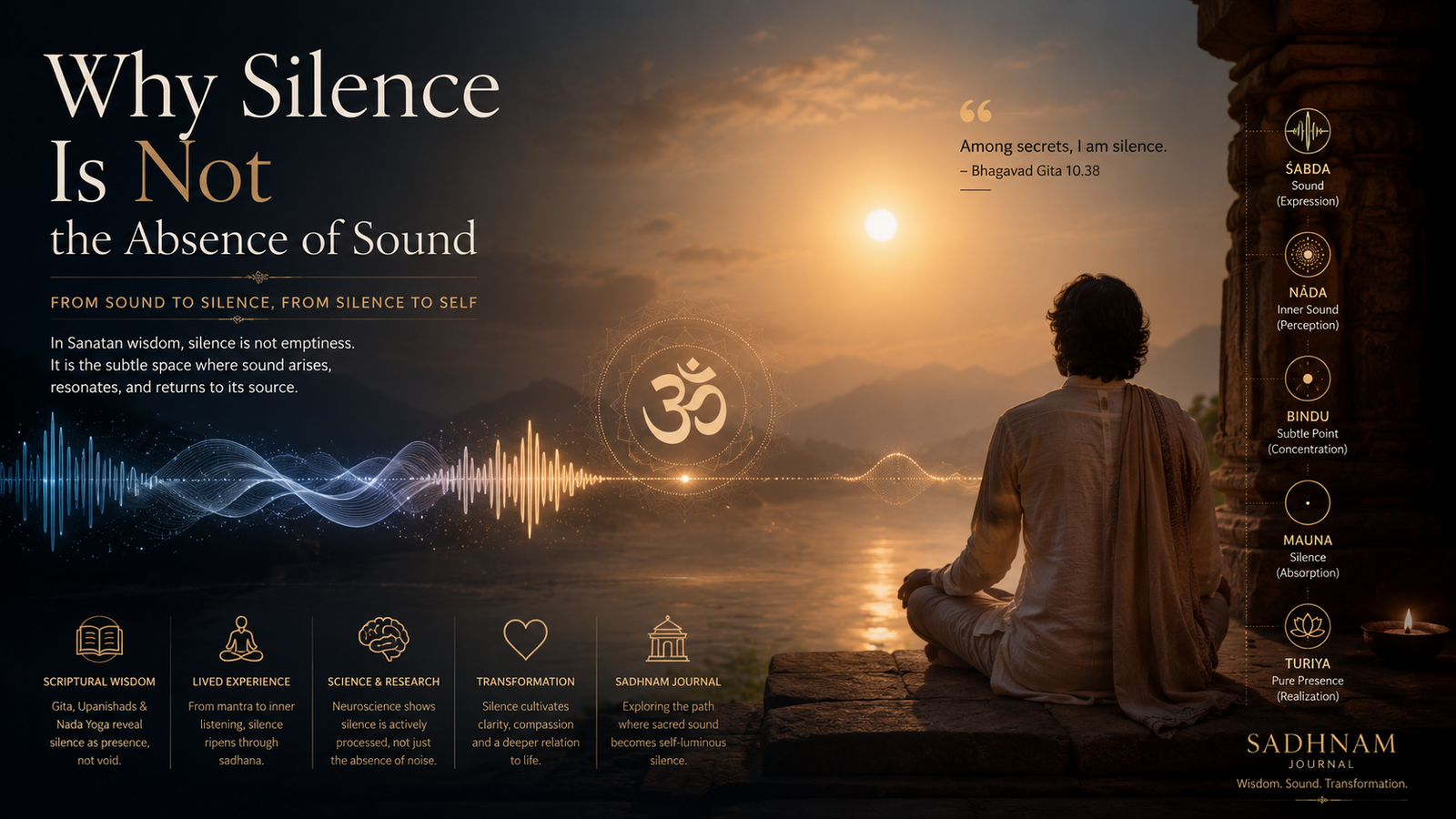
The scriptural case begins with mauna. In the Bhagavad Gita, silence is not presented merely as not speaking. In 17.16, mauna appears within the austerities of the mind: serenity, gentleness, silence, self-control, and purity of intention. In 10.38, Krishna goes further: “among secrets I am silence.” These verses are crucial for your article because they move silence from etiquette into ontology. Silence is not only a discipline; it is also a mode of divine disclosure.
The Katha Upanishad strengthens this point by describing the highest state as the stilling of the senses, mind, and intellect: “When the five organs of perception become still, together with the mind, and the intellect ceases to be active: that is called the highest state.” The next verse identifies that condition as yoga itself. Here silence is not acoustic minimalism; it is the quieting of the apparatus that ordinarily disperses consciousness outward.
The literature on Om, nāda and bindu then gives the essay its sonic metaphysics. The Gita’s 7.8 identifies Krishna as the sacred syllable Om in the Vedas and as “the sound in ether.” The Mandukya Upanishad opens by declaring Om to be the totality of existence, and its climactic seventh mantra describes the fourth state, turīya, as “peaceful, auspicious, non-dual.” The movement is striking: sound begins as symbol, becomes ontological totality, and culminates in a state described not as more speech, but as plenary peace.
The Nāda Bindu Upanishad and Dhyāna Bindu Upanishad sharpen the inward method. The former instructs the yogin to hear the internal sound through the right ear; the latter says that the seed-letter is the supreme bindu, that nāda is above it, and that when nāda ceases along with the letter, the nāda-less is the supreme state. The Maitrāyaṇīya Upanishad adds one of the most elegant formulations for your theme: the end of Om is “the silent, the soundless, fearless, sorrowless, joyful” Brahman. These sources together make a powerful doctrinal sequence for your essay: audible mantra → subtle inner sound → bindu-like concentration → soundless plenitude.
The bhakti traditions contribute something different but equally important: they make silence relational. The Bhagavata Purana 12.3.51 famously says that in Kali Yuga, liberation comes through kīrtana, the chanting and glorifying of Krishna’s name. In other words, bhakti does not oppose silence to sound; it proposes sound as a vehicle of intimacy and remembrance. In such a frame, the silence after kīrtana is not empty. It is a silence thick with after-vibration, feeling, and recollection. That gives your article a crucial corrective to modern secular quietism: in the Sanatan world, silence is often entered through sound, not simply by withdrawing from it.
Taken together, the scriptural tradition does not describe silence as a sterile acoustic zero. It describes silence as ethical restraint, inner composure, the quelling of phenomenal proliferation, the end-point of Om, and the consummation of listening. That is more than enough historical and textual foundation for a substantive SADHNAM essay.
Devrishi’s Sonic Philosophy and contemporary contemplative perspectives
The accessible primary Devrishi material frames Sonic Philosophy in terms that strongly support your proposed article. Official pages describe it as reviving the Indic insight that nāda is the primal essence of consciousness; they say Devrishi’s framework unites devotion, cognition, and vibration; and they present Sanatan Wisdom’s formulation of Sonic Philosophy, also called Dhvani Darshan, as a coherent path combining bhakti, nāda, and jñāna for the modern seeker. NYRI is described as the institutional research arm exploring mantra and sound-based interventions using tools such as EEG, HRV, and acoustic analysis.
What these official sources do not yet publicly specify, at least in retrievable form, is a detailed Devrishi-authored doctrine of silence itself. There are references to upcoming philosophical treatises such as Naad Vedanta and the Naad Darshan Sutra Series, but no public full-length text on this exact question was accessible in the present environment. Accordingly, the article can responsibly say that Sonic Philosophy implies a positive understanding of silence as an aspect of sound-consciousness, but it should not present that implication as a verbatim doctoral-style definition from Devrishi unless a more primary manuscript is supplied.
That limitation can actually become an editorial strength. The article can present itself as a research-backed journal essay by the author, not as an institutional white paper. In that form, the author’s voice can synthesise the available official framing with scripture, retreat phenomenology, and science. A useful formula here would be: Sonic Philosophy proposes that sound educates consciousness; this essay explores why the fulfilment of that education is silence. That formulation stays faithful to accessible official sources while allowing philosophical depth.
Contemporary contemplative traditions provide a practical bridge for global readers. Plum Village explains Noble Silence as something deeper than a ban on speech: one “doesn’t have to talk,” and silence becomes noble when the mind is calm and inwardly quiet. Spirit Rock’s retreat descriptions likewise frame silence not as total absence of communication, but as the container for guided practice, teaching and careful support. These are useful comparative references because they align with what your article needs to emphasise: contemplative silence is structured, relational, and intentional.
The most directly relevant contemporary research comes from the 2025 study on silent teacher-led residential retreats in mindfulness-based programme training. Participants and teachers described silent retreat as important for embodiment, for meeting difficulty, and for deepening teaching quality. Reported trajectories often began with anxiety, restlessness, drowsiness or frustration but, after a few days, gave way to groundedness, stillness, clarity, kindness, joy, equanimity and compassion. The teacher’s embodied presence was found to matter enormously, both positively and negatively. These findings map remarkably well onto the kind of retreat culture a SADHNAM article would want to describe: silence matures experience, but only when held with intelligence, steadiness and humane guidance.
Science, psychology and the phenomenology of silence
From the standpoint of auditory science, silence is far from a non-event. A 2006 fMRI study found that listening in silence activates auditory areas, suggesting that when attention is poised toward sound, the auditory system does not simply “switch off” in the absence of input. Related research on omission responses shows that the brain produces specific neural signatures when an expected sound fails to occur. SanMiguel and colleagues argued that human auditory processing relies on negatively coded predictions, and Chouiter and colleagues reported that experience-based auditory predictions modulate brain activity to silence as real sounds do. A recent review describes omission responses as a direct index of prediction and prediction error, because what is being processed is precisely the expected event that does not arrive.
This line of research has been pushed further by the 2023 PNAS paper The perception of silence, which argues that silences can substitute for sounds in classic auditory illusions and therefore may be genuinely perceived, not merely intellectually inferred afterward. For your article, this is gold: the phrase “silence is not the absence of sound” now has an experimentally respectable version. It does not mean that silence is literally a sound wave; it means that the human auditory mind processes meaningful absence as part of hearing itself.
Anechoic-chamber research adds another layer. Studies report that in environments of near-total external quiet, many participants perceive phantom sounds, and one 2022 experiment found that fear or perceived threat influenced the incidence and qualities of these percepts. This is an important contemplative insight as well as a scientific one: when outer sound drops away, the psyche often begins by hearing its own residue. In retreat language, what first appears in silence is often not peace but amplification—heartbeat, ringing, remembered phrases, grief, anticipation, self-talk. Silence reveals that “noise” is not only external.
The physiological literature is equally suggestive. Bernardi and colleagues found that music affects autonomic rhythms in relation to tempo, but that the pause after music can induce relaxation more strongly than the preceding exposure. A later review on silence and the autonomic nervous system proposes a useful distinction between outer silence and inner silence: outer silence can initially heighten alertness, whereas trained inner silence is associated with greater ventral-vagal regulation and less sympathetic stress activation. This distinction is highly valuable for the article, because it explains why beginners often find silence agitating while seasoned practitioners find it settling.
One finding often cited in popular writing needs careful framing. The 2013 paper Is silence golden? found that, in mice, exposing animals to silence increased hippocampal precursor proliferation and, after seven days, increased immature neurons relative to ambient noise. This is intriguing, but it is animal research, not proof that silence directly “grows new brain cells” in retreat participants. It belongs in the essay only if presented modestly, as suggestive evidence that altered auditory environments can affect neural plasticity in at least some organisms.
The consciousness literature helps explain why retreat silence can feel existentially different from ordinary quiet. Scanner background noise has been shown to suppress the default mode network, which means external sound can alter the brain’s resting baseline. Meanwhile, experienced meditators show differences in default-mode activity consistent with reduced mind-wandering, and Garrison’s neurofeedback work links posterior cingulate deactivation with reports of “undistracted awareness,” concentration, and observing sensory experience. Here the article can make a careful, non-reductive bridge: contemplative silence is not exhausted by brain states, but modern neuroscience does indicate that trained quiet states change how self-referential processing is organised.
Retreat outcome research broadly supports the idea that intensive practice can be helpful. Khoury’s meta-analysis found meditation retreats moderately to largely effective for stress, anxiety and depression, with strong effects on mindfulness and compassion; Montero-Marin’s one-month Vipassana study reported improvements in mindfulness, well-being and personality, even in experienced meditators. However, your article should not romanticise silence. Large-sample and adverse-effect studies show that some practitioners report unpleasant or disruptive meditation-related experiences, including anxiety, insomnia, emotional blunting and disturbances in the sense of self. For an intellectually credible SADHNAM piece, this caution is not a weakness. It is part of what distinguishes a contemplative journal from a wellness advertisement.
The following short diary fragments are illustrative composite vignettes, not verbatim testimonies. They synthesise patterns repeatedly reported in retreat and mindfulness-retreat research.
Day one. The silence is noisy. My mind fills the space instantly—unfinished emails, remembered songs, faces I did not invite. I thought silence would feel empty. It feels crowded.
Day three. I notice sound differently now: a sandal on gravel, a spoon touching steel, a bird-call reaching across distance. The world is not quieter. It is more articulate. My speech has gone down; listening has gone up.
Day five. Something has changed. The mantra no longer feels like something I am “doing.” It leaves a tone behind it, and that tone thins into a hush that is not blank. It feels inhabited. The silence is no longer behind the sound; it is inside it.
These vignettes embody the central interpretive claim of the essay: retreat silence usually begins as deprivation, then becomes revelation, and finally—if practice matures—relation.
Editorial blueprint for the SADHNAM Journal article
The article will work best at roughly 3,800–4,500 words, with a hybrid structure: philosophical opening, scriptural spine, scientific complication, retreat phenomenology, and practical application. The tables and diagrams below are designed to make drafting efficient.
Key sources with annotations
| Source | Why it matters for this article | Citation |
|---|---|---|
| Devrishi and the Rise of Sonic Philosophy | Official framing of Sonic Philosophy as an exploration of sound-consciousness, with sound treated as a medium of transformation and consciousness as inherently sonic | |
| Sanatan Wisdom homepage | Official public confirmation that Sanatan Wisdom links Sadhana, sacred sounds, Nada Yoga research, and a five-day retreat of “sound, silence and sadhana” | |
| NYRI Begins Scientific Exploration of Vedic Sound | Official indication that the movement intends to study mantra and sound with EEG, HRV and related methods | |
| Bhagavad Gita 17.16 | Establishes mauna as an austerity of the mind, not just social muteness | |
| Bhagavad Gita 10.38 | Presents silence as a divine attribute: “among secrets I am silence” | |
| Bhagavad Gita 7.8 | Connects Om and “sound in ether,” useful for linking sound, space and sacred hearing | |
| Katha Upanishad 2.3.10–11 | Defines the highest state as the stilling of senses, mind and intellect, and names that state yoga | |
| Mandukya Upanishad 1 and 7 | Om as totality; turiya as peaceful, auspicious and non-dual | |
| Nāda Bindu and Dhyāna Bindu Upanishads | Core textual evidence for inner sound, bindu, and the movement from sound to the soundless | |
| Maitrāyaṇīya Upanishad | Vital phrasing for the article’s thesis: the end is the silent, soundless, fearless, joyful Brahman | |
| Bhagavata Purana 12.3.51 | Grounds the bhakti claim that sacred sound is transformative and salvific through kīrtana | |
| Listening in Silence Activates Auditory Areas | Shows that silence can recruit active auditory processing | |
| Hearing Silences | Demonstrates neural responses to omitted expected sounds | |
| Experience-based Auditory Predictions Modulate Brain Activity to Silence as do Real Sounds | Strong evidence that silence is processed through predictive auditory models | |
| The Perception of Silence | Experimental support that silences can be genuinely perceived, not only inferred | |
| Bernardi on music and pauses | Useful physiological bridge: pauses can induce relaxation more strongly than the preceding music | |
| Is Silence Golden? | Interesting but limited mouse study on silence and hippocampal neurogenesis; use cautiously | |
| Silent Teacher-Led Residential Retreats | Best modern qualitative source for retreat embodiment, difficulty, compassion and teacher presence | |
| Khoury meta-analysis and Montero-Marin retreat study | Strong outcome evidence for benefits of intensive retreat practice | |
| Adverse-effects literature | Necessary for nuance, ethics and facilitator guidance |
Proposed article structure with target word counts
| Section | Purpose | Suggested words |
|---|---|---|
| Opening scene | Begin with a retreat moment where the practitioner realises silence is unexpectedly full | 300 |
| Thesis | State the central claim that silence is the fulfilment, not negation, of sacred sound | 250 |
| Mauna in the Gita | Show silence as mental tapas and divine attribute | 450 |
| Om, nāda, bindu, and the soundless | Build the Upanishadic arc from sounded mantra to soundless plenitude | 850 |
| Bhakti and kīrtan | Explain why devotional sound leads into charged silence rather than mere quiet | 350 |
| Devrishi and Sonic Philosophy | Position the article within the SADHNAM/Sanatan Wisdom worldview; note what is and is not publicly specified | 450 |
| Science of hearing silence | Present predictive coding, auditory omission, perception-of-silence and autonomic findings | 700 |
| Retreat phenomenology | Use composite diary-style passages to describe common stages of silence in practice | 450 |
| Practical implications | Offer guidance for mantra practitioners, retreat leaders and a 21-day introductory path | 550 |
| Closing cadence | End with a concise, memorable formulation linking mantra, listening and mauna | 200 |
| Total | 4,550 |
Mermaid timeline for the research base
Upanishadic horizonKatha Upanishad onstilling the sensesMandukya on Omand turiyaNada Bindu andDhyana Bindu oninner sound andbinduMaitri on thesoundless end of OmEpic and bhaktihorizonBhagavad Gita onmauna and sound inetherBhagavata Puranaon kirtana2006Listening in SilenceActivates AuditoryAreasBernardi on music,pauses, andautonomicrelaxation2011 to 2015Brewer and Garrisonon DMN and PCC inmeditationSanMiguel andChouiter onomissions andsilence prediction2013Mouse study onsilence andhippocampalprecursorproliferation2022 to 2025Anechoic-roomphantom soundresearchPerception ofsilence experimentsSilent retreatqualitative researchReview of omissionresponsesResearch arc behind the articleShow code
The ancient placements above are intentionally broad because exact datings remain debated across traditions and scholarly schools; the modern portion is taken directly from the cited research record.
Practical 21-day practice schedule
The schedule below synthesises the scriptural arc of sound to silence, the contemporary retreat literature on gradual settling, and the need for safety and structure in novice practice. It is a recommendation, not a canonical prescription.
| Day | Practice emphasis | Total time | Core instruction | Silence cue | Journal prompt |
|---|---|---|---|---|---|
| 1 | Arrival | 12 min | Sit, breathe naturally, chant mantra aloud for 5 min | Notice the pause after the final repetition | What felt louder: the mantra or my mind? |
| 2 | Rhythm | 12 min | Same mantra, even cadence | Lengthen the final pause by three breaths | What changes when I stop producing sound? |
| 3 | Listening | 15 min | 6 min voiced japa, 3 min silence, 6 min voiced japa | Hear room tone without naming it | What is present in “quiet”? |
| 4 | Speech restraint | 15 min | Morning practice before phone or conversation | Keep 5 post-practice minutes without speaking | How much energy goes into speech? |
| 5 | Somatic anchoring | 15 min | Add awareness of chest, throat, lips and tongue | Feel vibration dissolving into the body | Where does the mantra continue after sound ends? |
| 6 | Gentleness | 15 min | Soften effort; chant less forcefully | Rest in the after-sound | Did quiet feel restful or exposed? |
| 7 | Review day | 18 min | 8 min chant, 5 min silence, 5 min notes | Let silence be unforced | What has become easier? |
| 8 | Whispered mantra | 18 min | Shift from voiced to whisper for final 5 min | Observe subtler auditory attention | Is whisper closer to silence or sound? |
| 9 | Mental mantra | 18 min | 5 min voiced, 5 min whispered, 5 min mental, 3 min silence | Notice when mental sound continues | Does inner repetition feel heard or thought? |
| 10 | Bindu attention | 18 min | Place gentle attention between eyebrows or at heart | Rest attention on one inner point | Does a point of attention quiet the mind? |
| 11 | Inner hearing | 20 min | 5 min voiced, 7 min mental, 5 min listening | Attend to subtle hums, ringing, breath-tone | What remains when I do not initiate sound? |
| 12 | Noble speech window | 20 min | Keep one hour daily with no unnecessary speech | Protect the residue of practice | What happens to perception when speech reduces? |
| 13 | Walking silence | 20 min | 10 min seated, 10 min slow walking | Let footsteps become mantra-like | Does movement break silence or reveal it? |
| 14 | Review day | 22 min | Alternate 4 min mantra / 2 min silence three times | Compare first and last silent intervals | Is silence changing quality across days? |
| 15 | Extended mauna sit | 22 min | 7 min voiced or whispered japa, 10 min silence | Stay instead of correcting the mind instantly | What arises first in longer silence? |
| 16 | Difficulty as teacher | 22 min | Same pattern; name restlessness gently only after practice | Do not suppress discomfort | What did I learn from agitation? |
| 17 | Devotional inflection | 24 min | Offer mantra as address, not technique | Receive silence as response | Did devotion change the quality of quiet? |
| 18 | Kīrtan to quiet | 24 min | Short kīrtan track or chant, then seated silence | Notice emotional after-vibration | What remains after devotional sound? |
| 19 | Digital austerity | 24 min | No screens for 30 min before and after practice | Guard the transition into silence | How much of my inner noise is digitally fed? |
| 20 | Personal formulation | 25 min | Choose voiced, whispered or mental mantra wisely | Trust the most truthful mode today | Which form best opens silence for me? |
| 21 | Integration | 30 min | 10 min mantra, 10 min silence, 10 min reflective writing | Conclude with one intentional spoken line | What does silence now mean to me? |
Retreat session structure and facilitator cues
A beginner-friendly SADHNAM retreat session should alternate sound, silence, and integration, rather than dropping participants immediately into long unstructured quiet. That recommendation is supported by both scriptural logic and retreat research: the tradition itself moves from mantra toward stillness, and contemporary retreat studies emphasise the value of frameworks, teacher embodiment, and skilful support when difficulty arises.
Arrival and gentle orientationSet intention and safety frameGrounding breath and postureVoiced mantra or kirtanGuided transition into listeningSilent sitting or mental japaShort embodied check-inWalking silence or mindful movementSecond sit in deeper maunaOptional teacher interview windowClosing reflection and re-entry guidanceShow code
Facilitator cues should be simple but explicit. Explain that silence often gets noisier before it gets quieter; normalise restlessness, sadness, sleepiness and irritation; clarify that participants may request support; teach the difference between suppressing thought and loosening identification with thought; and remind the group that Noble Silence is not social coldness but shared inward care. Research on silent retreats shows that participants benefit from conceptual frameworks for difficulty, while contemplative institutions such as Plum Village explicitly define Noble Silence as inner quiet rather than mere prohibition of speech. Safety-conscious retreat culture is also warranted because some meditation-related adverse effects are documented in the literature.
A particularly strong facilitator sentence for this article and for retreat use would be: “We are not using mantra to escape silence; we are using mantra to become capable of hearing it.” That line is editorially effective because it condenses the whole thesis into a usable retreat instruction.
Recommended visuals and image concepts
The visual language should remain recognisably SADHNAM: indigo, muted dawn light, gold/bindu accents, uncluttered space, and a strong sense of interval rather than spectacle. Based on accessible public branding, this aligns with the organisation’s already visible sonic and sacred-practice identity.
| Visual | Concept | Suggested alt text |
|---|---|---|
| 16:9 hero image | Predawn riverbank or still courtyard in deep indigo; a single golden bindu-like point above a reflective surface; faint concentric ripples imply resonance emerging from stillness; one seated figure may be present but very small | “At predawn, a solitary meditator sits beside still water beneath a single golden point, while faint ripples spread through the blue-grey quiet, suggesting that silence is alive with resonance.” |
| Supporting image | Minimal diagram of sound → mantra → inner listening → mauna, using fine gold linework on off-white | “A minimalist four-step diagram showing the contemplative movement from audible sound to silent awareness.” |
| Scriptural image | Palm-leaf manuscript or Devanagari folio detail with Om and a subtle bindu motif | “Close detail of a Sanskrit manuscript page with the sacred syllable Om and a highlighted bindu-like point.” |
| Science sidebar image | Elegant visualisation of waveform with intentional gaps, paired with a simplified brain outline | “A stylised sound wave interrupted by measured gaps beside a simple brain diagram, representing the perception of silence.” |
| Retreat image | Empty meditation cushion after practice, with sandals nearby and morning light entering from one side | “An empty meditation cushion in soft morning light, suggesting the felt residue of practice after the practitioner has risen.” |
Suggested pull-quotes
- “Silence is not what remains when sound stops; it is what sound was trying to reveal.”
- “In mantra practice, the deepest teaching is often carried by the interval after the chant.”
- “Mauna is not muteness. It is the mind’s release from compulsion.”
- “Bhakti does not oppose sound to silence; it ripens sound into presence.”
- “The first silence of retreat is often crowded. The later silence is inhabited.”
- “When sacred sound becomes inward, silence begins to speak in its own register.”
These pull-quotes are best placed after the Gita section, after the Upanishadic section on Om/nāda/bindu, and after the phenomenology section, where they will feel earned rather than decorative.
Editorial note on attribution
For publication, the article can confidently cite Sanatan Wisdom, Devrishi, the Bhagavad Gita, the Upanishadic sources, and the contemporary science cited above. But if you want the finished piece to present Devrishi’s Sonic Philosophy in a more distinctively authorial voice, the report strongly recommends adding one or more of the following before final drafting: an internal note, an unpublished talk transcript, a lecture recording, or manuscript excerpts from Naad Vedanta or the Naad Darshan Sutra Series. Without those, the article can be powerfully aligned with the brand, but some finer doctrinal claims must remain interpretive rather than explicitly attributed.